I didn’t want melody. I was more interested in how harmony could float, rather than move forward like a musical line. My goal was to treat harmonic material as spatial texture—something that shifts, drifts, and evolves without resolution.
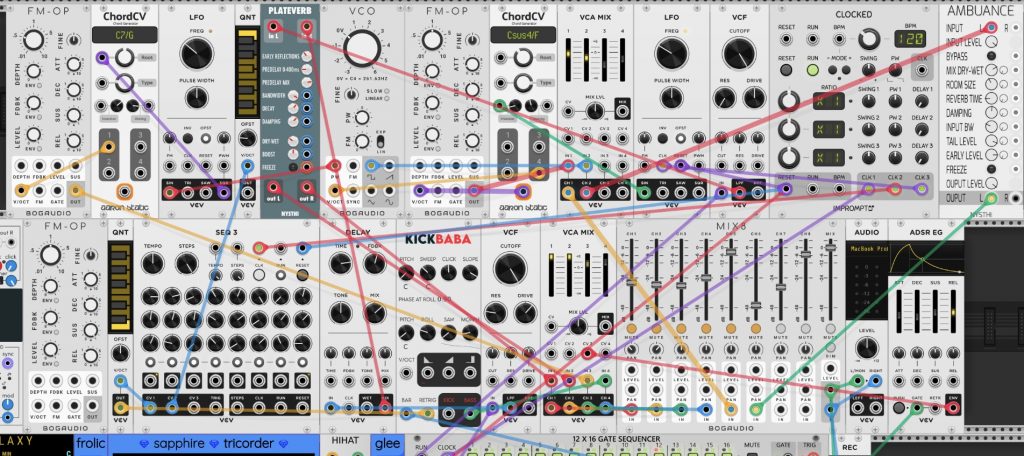
I used ChordCV to generate root chords, FM-OP for unstable timbres, and a basic VCO for low-end support. Each oscillator ran through separate audio chains:
ChordCV went into PlateVerb
FM-OP was filtered and sent to Valley Plateau
VCO passed through a delay to generate spatial resonance in the low range
For modulation, I avoided envelopes and used multiple LFOs and a Lorenz attractor. These were patched into pitch inputs, filter cutoffs, FM depth, and reverb size.
ChordCV’s pitch fluctuated slightly via a slow triangle LFO
FM-OP’s modulation index was pushed by chaotic CV
Reverb decay and diffusion were also modulated, letting space itself shift over time
All audio signals were routed into a MixMaster, where I handled stereo panning and reverb send levels independently. Each voice was placed differently in space.
I avoided wavetable or sample-based voices because they felt too rigid. Simpler oscillators gave me more responsive control—they behaved under modulation, becoming texture instead of tone.
Inspired by Brian Eno, I stopped thinking of harmony as movement and started treating it as condition. This patch didn’t develop musically—it existed spatially.
Leave a Reply